
1 min read
How to Optimize Your Google Business Profile for Local Search
When a potential customer searches for a service in your area, your Google Business Profile is often the first thing they see. Before they visit your...
Website Design
Web Hosting
Website Refresh™
Search Engine Optimization
| Branding | |
| Media Buying | |
| Graphic Design | |
| Copywriting | |
| Public Relations |
4 min read
Team Advanté-BCS
:
September 25, 2023
📆 Updated on May 7, 2026
Before a new customer calls your business, there is a good chance they have already read what other people say about you. Reviews have become a standard part of how people evaluate local service businesses, and for most small businesses, the volume and quality of those reviews has a direct impact on how many new leads walk through the door.
This post covers why reviews matter, how they affect your search visibility, and what you can do to generate more of them consistently.

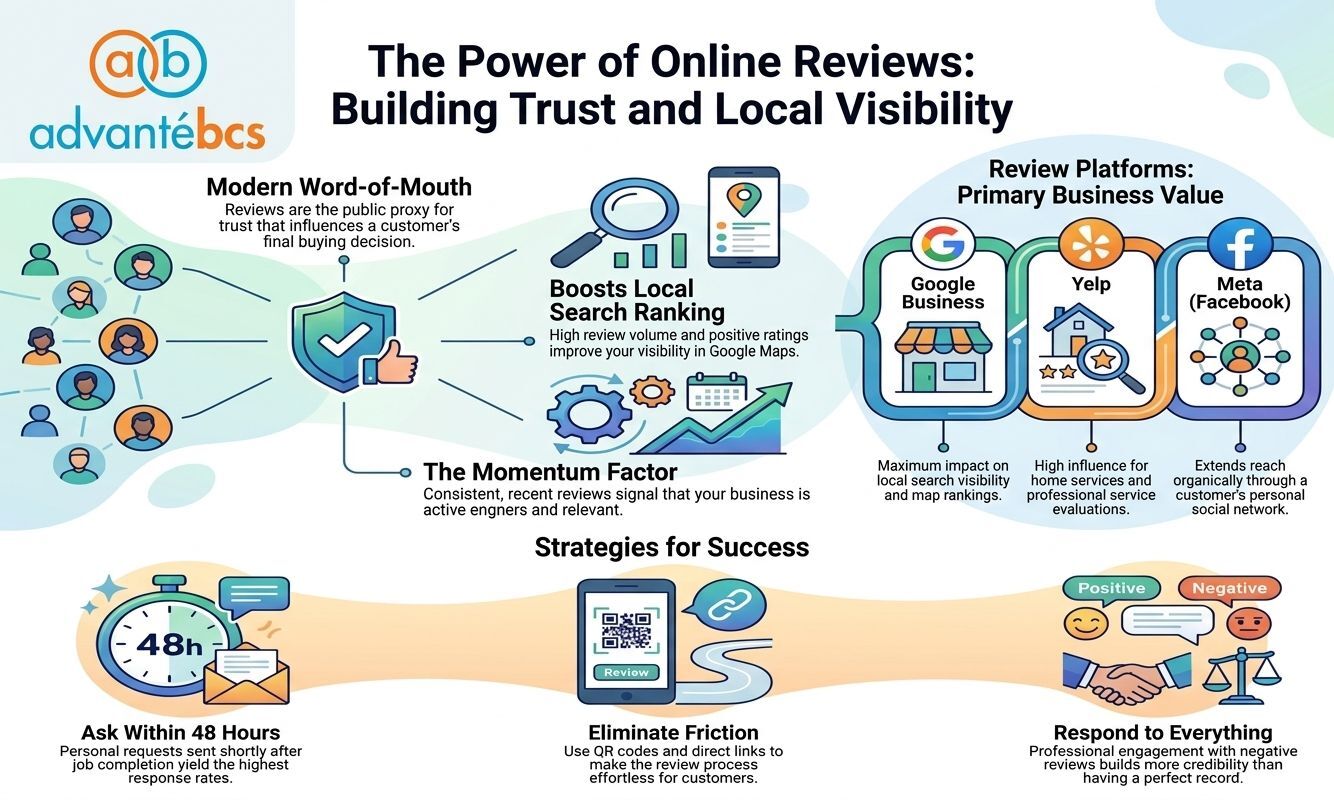
Embed this infographic:
Reviews function as modern word-of-mouth. A potential customer who does not know your business personally will look to others' experiences to decide whether to trust you. Positive reviews build that trust quickly. A strong rating signals reliability, quality of work, and good customer service before a single conversation takes place.
Negative reviews, handled well, can also work in your favor. Customers understand that no business is perfect, and a business that responds to criticism professionally and constructively often comes across as more credible than one with an unblemished but suspiciously thin record. What matters is how you engage, not just what the rating says.
The practical implication for a local service business is straightforward: a competitor with more reviews and a higher average rating will win the comparison most of the time, even when the quality of service is comparable. Reviews are a visible, public proxy for the trust that used to be built through personal referrals.
For local service businesses, reviews do more than influence potential customers. They directly affect how visible your business is in Google Search and Google Maps. According to Google's own guidance on local rankings, more reviews and positive ratings can help improve where your business appears in local results. Google evaluates your business's prominence, and reviews are among the clearest signals of it.
A consistent stream of recent positive reviews signals to Google that your business is active, trusted, and relevant to local searchers. A stale profile with few reviews, or a cluster of old reviews and nothing new, sends the opposite signal. For a home service company competing in a specific geographic area, that difference in review momentum can mean the gap between appearing in the local map pack and not appearing at all.
Responding to reviews matters too. Google's guidance specifically notes that replying to reviews demonstrates that you value customer feedback, and that engagement is factored into how your profile is assessed. Responding to every review, positive and negative, is one of the simplest and most overlooked ways to strengthen your Google Business Profile.
Your Google Business Profile should be the primary focus because it has the most direct impact on local search visibility. But spreading your review presence across multiple platforms gives customers options and reinforces credibility across the web.
Displaying reviews directly on your website is also worth doing. Embedding your Google reviews or featuring testimonials on key service pages reinforces trust when a visitor is evaluating whether to contact you.
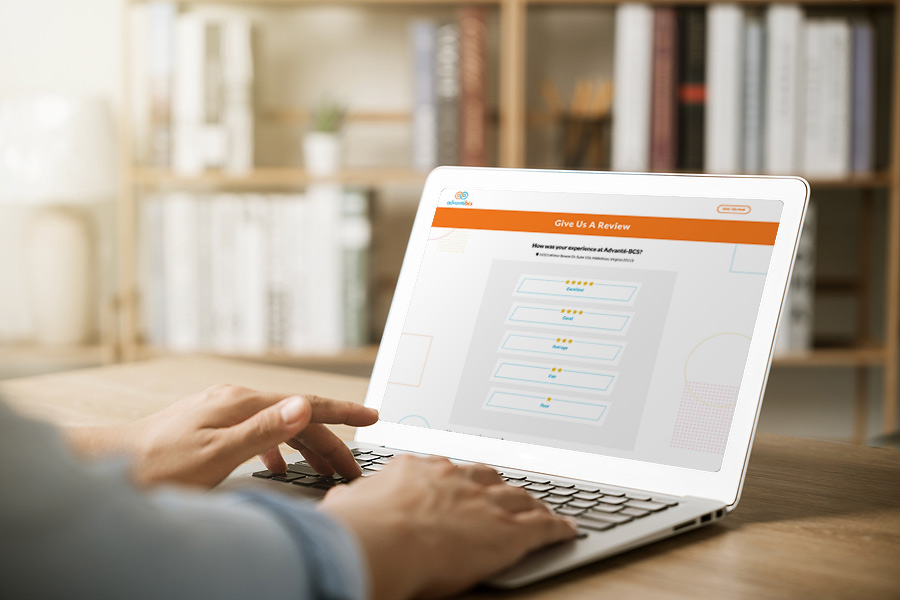
Most customers who had a good experience will leave a review if asked directly and made to feel that their feedback matters. The challenge for a busy service business is building that ask into a consistent process rather than leaving it to chance.
The most effective approach is a timely, personal request shortly after the job is complete. A follow-up text or email sent within 24 to 48 hours, while the experience is fresh, will outperform a generic reminder sent days later. The message does not need to be elaborate: a brief thank-you and a direct link to your Google review page is enough.
Automated review requests can handle this at scale. Once set up, a trigger fires at the right moment in your workflow, whether that is after a service is marked complete, a follow-up email is sent, or an invoice is paid. This removes the reliance on any individual remembering to ask and ensures every customer gets the same timely outreach.
The simpler the process, the more reviews you will receive. Friction at any point in the review flow, whether a confusing link, too many steps, or uncertainty about where to go, reduces completion rates significantly.
A direct link to your Google review page, shared via text, email, or a QR code on your vehicle, business card, or door hanger, removes most of that friction. The easier you make it for a satisfied customer to leave a review in the moment, the more likely they are to follow through. That kind of systematic approach is what separates businesses with 200 reviews from those with 20, even when the quality of service is comparable.
Responding to every review, positive and negative, is one of the most overlooked parts of a review strategy. For positive reviews, a brief, personalized response acknowledges the customer by name, reflects something specific about their experience, and gives them a reason to return. Generic responses that sound like they came from a template do the job but miss an opportunity to deepen the relationship.
Negative reviews require more care, and that is where most businesses struggle. The natural instinct when a customer says something hurtful or factually wrong is to defend yourself. That instinct is understandable, but acting on it publicly almost always makes things worse. The response that serves your business best acknowledges the concern, apologizes for the experience without admitting fault where none exists, and offers to continue the conversation offline. That approach signals to everyone reading the review that you are professional and take feedback seriously.
Businesses that are too close to a difficult review to respond objectively often benefit from having a third party draft the response. At Advanté-BCS, we have helped a number of clients navigate exactly this situation: writing responses to highly negative reviews where the client, understandably, felt too personally affected to follow best practices. An impartial perspective makes it easier to respond in a way that protects the business's reputation without escalating the conflict.
For businesses with staff who handle review responses directly, a written guideline helps ensure consistency. This is a practical document that gives team members a clear framework for responding to positive reviews, negative reviews, and reviews that appear to be fake or spam. Having that standard in place means responses are handled professionally, regardless of who is managing the account on any given day.
If you would like to talk through how a review generation or review response strategy could work for your business, reach out via our contact page or call us at (804) 788-0048. For more on managing your business's online presence, see our post on how to manage your online reputation.
1 min read
When a potential customer searches for a service in your area, your Google Business Profile is often the first thing they see. Before they visit your...
1 min read
Owning a home service business often means wearing every hat at once. You are responsible for your team, your customers, and the quality of every job...
1 min read
When someone wants to learn more about your business, the first thing they do is search for it. What they find in those first few results shapes...