
The Power of Online Customer Reviews
 Team Advanté-BCS : September 25, 2023
Online reviews shape buying decisions and affect your local search rankings. Here's why they matter and how to get more of them working for your...

 |
Branding |
 |
Media Buying |
 |
Graphic Design |
 |
Copywriting |
 |
Public Relations |
5 min read

When someone wants to learn more about your business, the first thing they do is search for it. What they find in those first few results shapes whether they call you, visit your site, or move on to a competitor. That is what online reputation management is about: making sure what people find about your business reflects it accurately and favorably.
Reputation used to travel slowly. A dissatisfied customer might tell a few people. A happy one might refer a neighbor. Online, both experiences spread faster and reach further. Reviews, social mentions, directory listings, and search results all contribute to the picture a prospective customer forms before they ever contact you. Managing that picture deliberately is one of the most practical things a local service business can do.
Online reputation management, or ORM, is the ongoing process of monitoring, shaping, and maintaining how your business is perceived across the internet. It covers everything from your Google Business Profile and review ratings to how your brand appears on social media and what surfaces when someone searches your business name.
ORM is sometimes confused with public relations. The two overlap in that both concern how your business is perceived, but PR focuses on relationships with journalists, publications, and traditional media. ORM focuses specifically on your digital presence, the channels you can monitor directly and respond to in real time.
The practical scope of ORM for a small service business is narrower and more manageable than it might sound. It means keeping your profiles accurate and active, consistently generating and responding to reviews, and staying aware of what is being said about your business so you can address problems before they compound.
Your online reputation affects your business in three direct ways: it influences whether prospects choose you over a competitor, it affects how high you appear in local search results, and it shapes how existing customers perceive the quality of their experience with you.
On the search visibility side, Google's own guidance on local rankings makes clear that review volume, rating quality, and profile completeness all factor into where a business appears in local results. A business with a well-maintained profile and a steady stream of recent positive reviews has a structural advantage over one with an outdated listing and sparse feedback, even if the quality of the actual service is comparable.
On the trust side, a prospect who finds a business with no reviews, outdated information, or unanswered negative feedback is likely to move on. The absence of a visible, managed reputation is itself a signal. A business that responds to reviews promptly and professionally, keeps its information current, and maintains a consistent presence across platforms communicates reliability before a single conversation takes place.
Three categories of content contribute to your online reputation, and each one requires a different kind of attention.
Owned media is content your business creates and controls directly: your website, blog, social media profiles, and any other channels where you set the message. This is where you define your brand voice, clearly communicate your services, and give prospective customers a reason to choose you. Because you control it completely, owned media is the foundation everything else builds on.
Earned media is what others say about your business without you paying for it: customer reviews, press mentions, social shares, and word-of-mouth referrals that appear online. This is the most credible category because it comes from independent sources. A strong review profile, consistent mentions in local community groups, and positive coverage from local publications all contribute to earned media. You cannot buy it directly, but you can create the conditions that generate it.
Paid media covers advertising in its various forms: paid search, social media ads, sponsored content, and display advertising. For reputation purposes, paid media is most useful for ensuring your business appears prominently in search results for what you offer and for promoting content that reinforces the story you want to tell about your brand.
Most small service businesses will find that owned and earned media do the most work for their reputation. A well-maintained website, an active Google Business Profile, and a consistent stream of genuine customer reviews are the three pillars that matter most.
Before building or refining an ORM strategy, you need to know where things stand. Start with a systematic review of every place your business appears online.
The audit does not need to be exhaustive, but it should give you a clear picture of what a prospective customer sees when they look for you, and where the gaps or problems are.
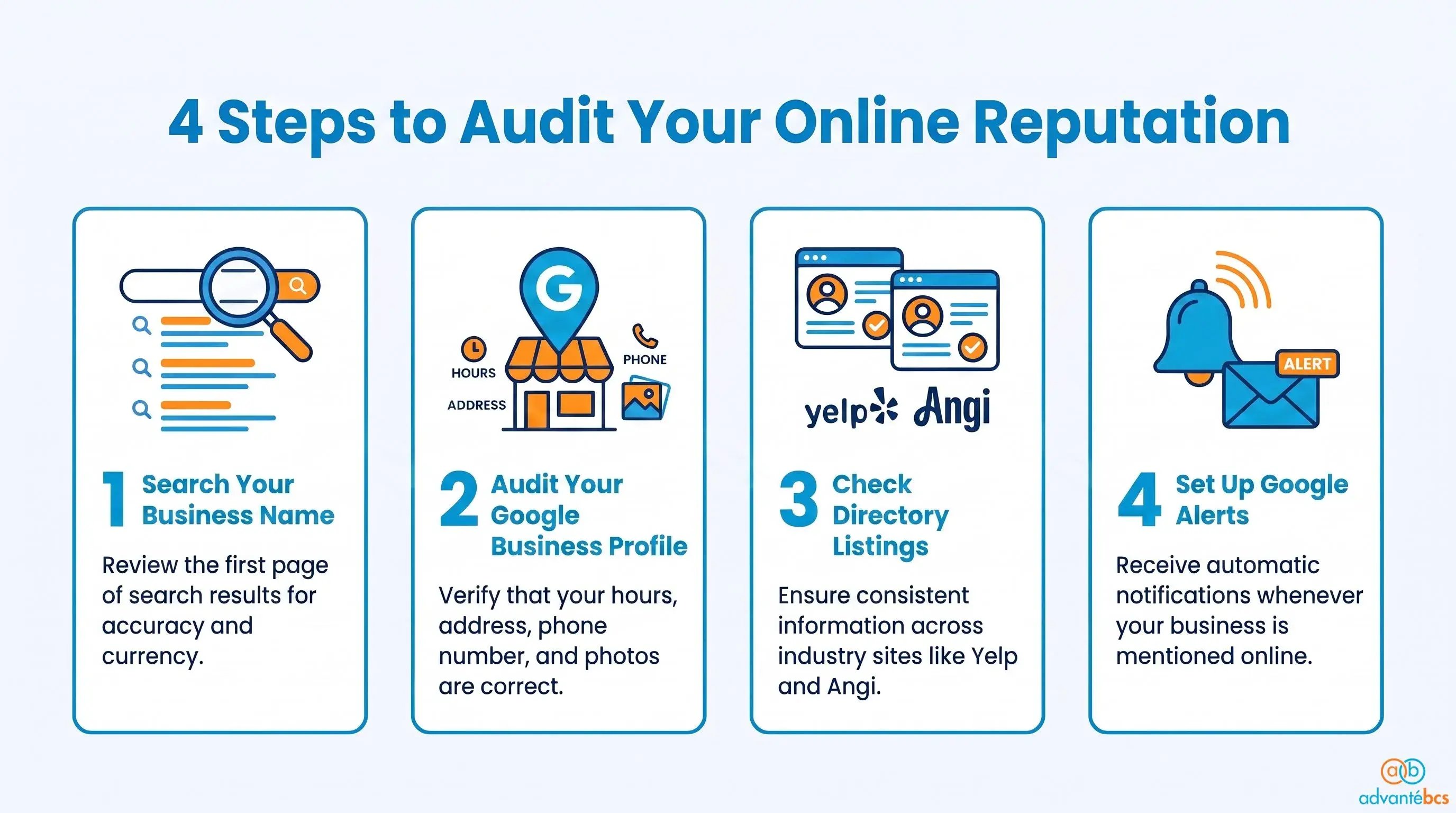
Infographic highlights the key steps to conduct an online presence audit
Reviews are the most visible part of your online reputation for most local service businesses. They appear prominently in search results, influence click-through rates, and factor directly into local search rankings. Managing them well means both generating new reviews consistently and responding to every review you receive.
Positive reviews should be acknowledged personally and specifically, not with a generic template response. Referencing something from the reviewer's experience, even briefly, signals that real people are behind the business and that customer feedback is genuinely valued.
Negative reviews require a professional, measured response regardless of whether the criticism feels fair. Acknowledge the concern, apologize for the experience, and offer to continue the conversation offline. That approach serves two audiences: the reviewer, who may reconsider their position, and every prospective customer who reads the exchange afterward. For more details on how to build a review generation and response strategy, see our post on the power of online customer reviews.
Reputation is built through accumulated interactions, not a single campaign. How your business responds to questions, comments, and feedback across platforms shapes the perception of your brand over time.
On social media, that means responding to comments and messages promptly, engaging with content from your local community, and posting content that is genuinely useful or relevant to your audience rather than purely promotional. A business that participates actively in its community online builds the kind of ambient trust that influences buying decisions even when a prospect is not actively looking to purchase.
Consistency matters more than volume. A business that posts occasionally but responds to every comment and review builds a stronger reputation than one that publishes frequently but ignores the conversation happening around it. Setting a realistic cadence and maintaining it is more valuable than bursts of activity followed by silence.
For a closer look at how to protect your brand presence on social media, our post on effective strategies to protect your brand's online reputation covers the topic in more depth.
An ORM strategy only works if it is maintained. Monitoring means more than checking your Google reviews once a week. It means having a process in place to catch new reviews, social mentions, and profile changes quickly and address them before they become problems.
For most small businesses, this does not require sophisticated software. A combination of Google Alerts, regular profile check-ins, and a defined schedule for reviewing and responding to feedback covers the basics. What matters is that the process is documented and assigned, not left to whoever happens to notice something.
The businesses that manage their reputations most effectively treat it as an ongoing operational task, not a one-time project. A reputation built steadily over time, through genuine service, consistent engagement, and professional handling of feedback, is far more durable than one assembled quickly and then left unattended.
If you would like help building an ORM strategy that fits your business, reach out through our contact page or call us at (804) 788-0048.
 Team Advanté-BCS : September 25, 2023
Online reviews shape buying decisions and affect your local search rankings. Here's why they matter and how to get more of them working for your...
 Team Advanté-BCS : May 22, 2026
AI is reshaping how customers search for and choose local businesses. Learn what this means for your visibility and how to stay ahead of the shift.
 Team Advanté-BCS : June 15, 2026
AI tools can save time and improve results for small businesses. Here are three practical ways business owners in Richmond, VA, can start using AI.