
Driving Traffic With Website Development, Explained
 Team Advanté-BCS : February 11, 2021
A well-built website does more than look good. It actively brings customers to you. Learn how website development, SEO, speed, and design work...

 |
Branding |
 |
Media Buying |
 |
Graphic Design |
 |
Copywriting |
 |
Public Relations |
5 min read


Every business owner, at some point, wonders whether investing in a well-built website is actually worth it. The answer shows up in the numbers, and the numbers are hard to argue with.
We have seen this play out directly with clients. When a business relaunches its website, something interesting happens. Some of the performance gains make obvious sense: adding a phone number prominently in the header, for example, reliably increases inbound calls. But there is also something below the surface that is harder to measure. When a business owner genuinely loves their new website, they start promoting it without being asked. A service company adds the URL to their vehicle lettering. A healthcare provider mentions it on invoices. Someone posts about the launch on social media. That enthusiasm has a real impact on traffic and new customer acquisition that goes well beyond any single design tweak. A great website gives businesses something worth pointing people to, and they do. Here are ten statistics that explain why getting your website right matters so much for attracting new customers.
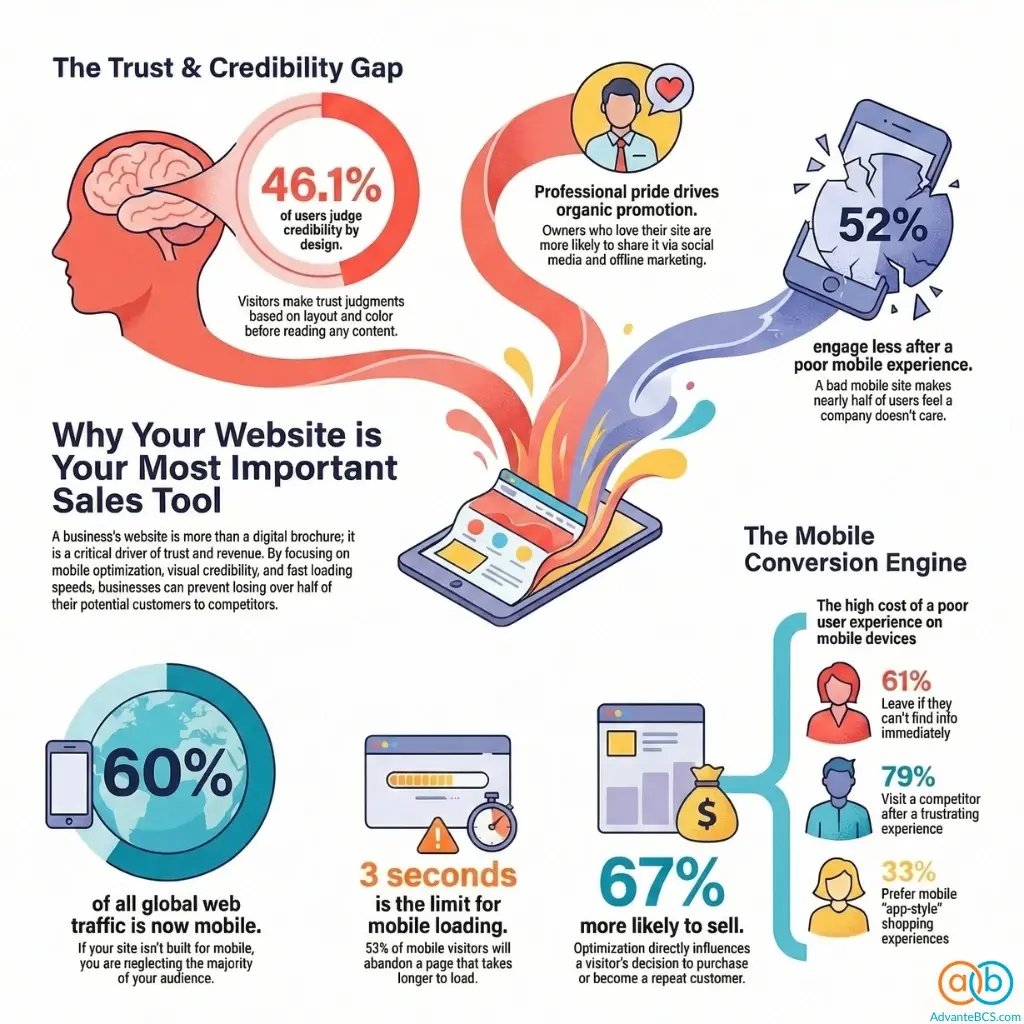
Mobile is not just where some of your customers are browsing. According to StatCounter Global Stats, mobile devices accounted for approximately 60% of global web traffic as of 2024. That figure is even higher in certain regions and industries, though in North America the split is closer to 50–54% mobile. The practical takeaway is the same regardless of which end of that range applies to your market: if your website is not built with mobile visitors in mind, a significant share of the people trying to reach you are getting a worse experience than they should be.
A study from the Stanford Web Credibility Project found that 46.1% of users assessed a website's credibility based primarily on the visual design, including the layout, typography, font size, and color scheme. That means nearly half of your visitors are making a trust judgment before they have read a single word of your content. A cluttered layout, inconsistent fonts, or an outdated design can undermine confidence in your business before you have had a chance to say anything. This is especially true for service businesses, where trust is the foundation of the entire customer relationship.
Research from Think with Google found that 61% of mobile users say they will quickly move on to another site if they do not find what they are looking for right away. And 79% of people who have a frustrating experience on one site go straight back to search and find a competitor. Your website needs to answer basic questions fast: what you do, where you operate, how to reach you, and what to do next. If those answers require digging, a large portion of your visitors will not stick around long enough to find them.
The same Google research found that 67% of mobile users say they are more likely to purchase from a site that is well-optimized for mobile. The inverse is also true: 50% of people say they will use a business less often if the website does not work well on their phone. A mobile-friendly experience is not just about good design. It directly influences buying decisions and whether someone becomes a repeat customer.
The same 2012 Google study found that 52% of users said a bad mobile experience made them less likely to engage with a company. Perhaps more striking, 48% said it made them feel like the company did not care about their business. A slow, broken, or hard-to-navigate mobile site does not just lose a transaction. It shapes how people think about your company as a whole. That perception is difficult to reverse.
Google's "The Need for Mobile Speed" report found that 53% of mobile site visits are abandoned if the page takes longer than three seconds to load. The average mobile site at the time of the study took 14 to 19 seconds to fully load on common connections. Fast hosting, optimized images, and a clean site build are not technical luxuries. They are the baseline for keeping visitors on your site long enough to do anything.
Most visitors land on your homepage already knowing what they want to find. They are looking for services you offer, your location or service area, how to contact you, and some indication that you are a real, credible operation. If any of those answers are buried, missing, or hard to read on a phone screen, many of those visitors will not wait for a better experience.
A clear structure, visible contact information, and a homepage that quickly communicates what you do and who you serve is not complicated to build, but it makes an outsized difference in whether visitors take the next step. A few specific elements that matter most:
Content can explain what you do, showcase your work, and answer objections. But without a clear call to action, many visitors will simply leave once they have read enough. A call to action gives someone a low-friction next step, whether that is calling you, requesting a quote, booking a service, or reading more.
Good calls to action are specific, easy to find, and matched to where someone is in their decision. Common places where CTAs make the biggest difference:
A 2022 NewStore survey of 610 U.S. consumers found that 1 in 3 consumers prefer mobile shopping apps to any other channel, and that app preference was especially strong among people aged 18 to 44. Not every business needs a dedicated app, but this data reflects a broader expectation: people want mobile experiences that are fast, intuitive, and easy to navigate. A well-built mobile website that performs like a modern application meets that expectation without requiring a full app development project.
Email marketing remains one of the highest-return channels for small businesses. What has changed is where people read those emails. Multiple industry sources, including Litmus and HubSpot, consistently find that between 55% and 65% of email opens happen on mobile devices. If your emails link back to a website that does not perform well on mobile, you are losing the return on every email you send. The email and the landing page need to work together, and both need to hold up on a small screen.
The statistics above are not abstract. They describe what is happening on your website right now, every time a visitor lands on a slow page, struggles to find your phone number, or leaves because the mobile experience did not hold up.
A well-built website does not happen by accident. Speed, structure, design, and clear calls to action are decisions made during development, and getting them right is what separates a website that generates business from one that quietly loses it.
If the numbers in this post sound familiar, it may be time to take a harder look at how your site was built. Our custom website development team can help you identify what is holding your site back and what it would take to fix it. We also offer a Website Refresh service for businesses that want a meaningful upgrade without a full rebuild. To talk through what might make sense for your situation, contact our team and we can take a look together.
 Team Advanté-BCS : February 11, 2021
A well-built website does more than look good. It actively brings customers to you. Learn how website development, SEO, speed, and design work...
 Team Advanté-BCS : April 25, 2025
Outdated websites lose leads. Learn why regular updates and a strategic website redesign help your business stay competitive in today’s market.
 Team Advanté-BCS : February 13, 2026
Explore the pros and cons of migrating your Joomla website to WordPress, including ease of use, functionality, and available support.